
White Paper: Building the future - Australia's next timber opportunity is engineered
Australia’s housing construction market is changing with the shift toward engineered wood products creating new opportunities to deliver more value locally, in our regional communities.
The strongest housing growth is no longer concentrated in detached homes. In 2025, townhouse approvals increased by 20.5 per cent, while approvals for four-to-eight-storey buildings increased by 70.5 per cent. By comparison, house approvals increased by just 1.9 per cent. These figures point to a construction market that is becoming more reliant on multi-residential, mid-rise and higher-density formats.
That matters because these buildings require construction systems that can deliver greater consistency, precision and productivity. They create an opportunity for products that can be engineered, standardised and manufactured off site before being assembled efficiently on site. Engineered wood products are increasingly part of that opportunity. But the market data shows that Australia is currently meeting much of its growing EWP demand through imports.
The latest analysis by IndustryEdge shows, in 2025–26, Australia imported $1.941 billion of major wood products, an increase of 10.8 per cent, or $189 million, on the previous year. Engineered wood products accounted for $676.9 million of that total, up 6.2 per cent. This occurred despite a relatively modest increase in housing approvals and otherwise unremarkable demand conditions. In other words, the increase cannot be explained simply by a construction boom. It points to a deeper shift in the products being specified, purchased and used in Australian construction.
The clearest example is the growing consumption of Laminated Veneer Lumber - LVL. Formally reported imports reached 254,065 cubic metres in 2025–26, growing from 167,229 cubic metres in 2024–25 compared with 95,919 cubic metres in 2022–23 – a three year increase of more than 160 per cent. It’s estimated total LVL imports will exceed 300,000 cubic metres annually in the near term.
The value of those imports reached $159.9 million in 2025–26. Yet the average import price fell to $629 per cubic metre, down from $821 the previous year and $1,294 in 2022–23. That combination: rapidly increasing volumes and falling prices, is significant. It suggests that overseas manufacturers are not simply supplying a temporary shortfall, they are establishing a stronger position in the Australian market.
LVL is not the only engineered or manufactured wood product experiencing this pressure. Plywood imports increased to 656,014 cubic metres in 2025–26, up from 525,599 cubic metres the previous year. MDF imports reached 183,547 cubic metres, compared with 122,921 cubic metres in 2024–25. In both cases, import volumes rose sharply while average import prices fell.
Taken together, the figures show an important change in Australia’s timber market. The rise of engineered wood products is not a distant prospect: they are already being consumed at significant and growing volumes. The market is rapidly forming now, but the majority of the manufacturing capacity supplying the demand is being delivered offshore.
That is the central issue Australia needs to confront. At a time when housing delivery is under pressure from system and labour shortages, construction costs, productivity constraints and limited capacity, more must be done with less. Engineered timber, prefabrication, standardised components, advanced manufacturing and latest technologies all have a role to play in making construction more predictable, cost effective and efficient.
The growth in prefabricated building imports provides further evidence of this transition. Imports of prefabricated building products increased by 52.6 per cent in 2025. Prefabricated buildings and modular building products were worth $333 million in imports during the year, while imports in the first four months of 2026 had already reached almost $226 million. If that pace were maintained, it would equate to an annual value of around $678 million. Not all these products are made from timber, but the trend is clear - Australia is increasingly importing complete or partially completed dwellings.
The significance of this shift extends beyond the import bill. Every engineered timber product manufactured overseas represents value that has been created outside Australia. The engineering, capital investment, manufacturing expertise, production jobs and associated supply-chain activity are captured in another country before the product arrives on Australian-shores.
Australia already possesses one of the foundations required to participate in this market more effectively - the raw material, and it comes at scale. The country has a substantial plantation estate, an established industry and decades of expertise in growing, harvesting, transporting and processing timber. The Green Triangle, spanning south-west Victoria and south-east South Australia, is one of the strongest examples of this capability.
The region has world recognised plantations, the forestry businesses and expertise, the transport infrastructure, the ports and the international supply chains. It does not need to create a resource base from scratch. It has the opportunity to connect that existing capacity and existing wood processing facilities, to the next stage of market development for manufacturing underpinned by engineered wood products.
This is the opportunity behind The Precinct. It is not simply a proposal to manufacture another timber product. The central proposition is to establish a more complete regional value chain, one that connects plantation-grown fibre with engineered wood products, building component manufacturing and, ultimately, the construction systems increasingly demanded by the Australian market.
This approach does not replace Australia’s export role. Exports will remain an important part of the forest industry’s contribution. The Green Triangle will continue to participate in international commodity markets. The opportunity is to complement those exports by developing higher-value, domestic manufacturing capability delivering solutions for Australia’s dwellings.
That distinction and the diversified value chain matters for regional economies. Manufacturing engineered wood products locally helps retain more value within the domestic economy, creates more skilled jobs and supports businesses in engineering, technology, maintenance, transport, logistics and construction – additional service industries.
New, higher-value markets for plantation-grown fibre, providing Australian builders and developers greater access to genuinely sustainable and locally manufactured products is driving decision making for The Precinct. Importantly, this is positioning the Green Triangle to respond to a market that is already changing.
The growth in townhouse and mid-rise dwelling demand shows Australia’s housing mix is moving beyond the detached house. The rapid increase in LVL imports shows that engineered wood products are becoming a more important part of the material mix. The rise in prefabricated building imports and the growing emphasis on prefabrication in Australia, shows that construction is increasingly incorporating manufacturing models.
These trends are not separate. They are different expressions of the same transition: buildings are becoming more reliant on systems, components and products that can be designed, engineered and manufactured with greater precision before they are installed on site. From LVL, Plywood, MDF and prefabricated components, all the data is showing a rising trend. It shows no sign of slowing.
The Precinct development provides a pathway to deliver this market need. It offers the potential to connect a significant plantation resource with a growing market for engineered wood products and prefabricated construction components.
Australia’s market is already demonstrating where the opportunity lies – it’s time for the sector to deliver the answers, extending and defending Australia’s sovereign manufacturing capability to deliver on one of society’s essential needs: locally produced housing solutions.
Recent News

August 21, 2026
Forestry Investment Leader David Brand to Headline The Precinct Investor Symposium
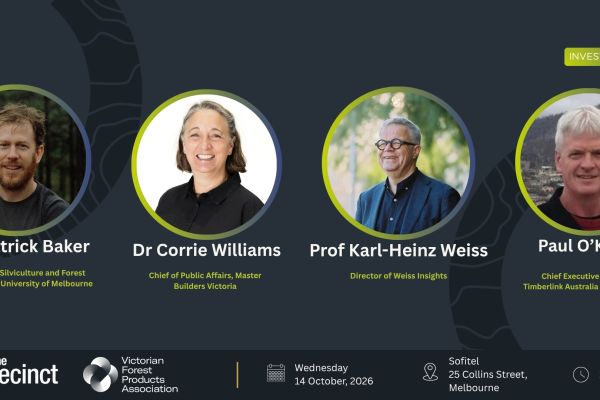
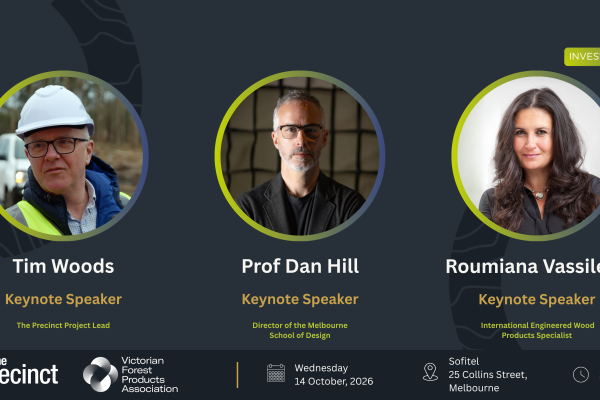
Influential forestry investment leader Dr David Brand will headline an Investor Symposium hosted by The Precinct in Melbourne this October as investors explore an initial $200 million-plus opportunity to establish large-scale engineered wood product manufacturing in Victoria’s Green Triangle. Dr Brand, founder of global forestry investment manager New Forests, will deliver a keynote address on 14 October 2026, drawing on more than four decades of experience across forestry investment, forest management and natural capital. Russ Hughes, chair of The Precinct and former CEO of Australian Bluegum Plantations, will host the invite-only event as investors assess the commercial pathway, market opportunity and investment case for the world scale Precinct development, proposed for Portland in south-west Victoria. The event marks a return to the investment origins of Dr Brand’s work in Australia. He founded New Forests in 2005 with a single forestry asset in the Green Triangle with the goal of bringing institutional capital into the plantation sector. The business has since grown into a global operation with $10.6 billion in assets under management with a portfolio covering plantations, timber processing, agriculture, conservation, carbon and natural capital. From the outset, Dr Brand recognised that the value of a forest extended well beyond the sale of wood fibre. His work helped advance a more sophisticated view of forestry as an asset class, capable of delivering additional value through carbon, biodiversity, conservation and broader landscape outcomes. Just as carbon created a new way to value plantations, Dr Brand will explore the next evolution of the sector, transforming established plantation resources, traditionally exported as raw fibre, to be the feedstock for higher-value, domestically produced engineered wood products and prefabricated construction systems - markets experiencing strong domestic demand and constrained supply. The symposium follows the completion of the Hardwood Timber Manufacturing Hub feasibility study, which confirmed the technical and commercial pathway for the initial stage of The Precinct development. The proposed initial stage, earmarked close to port and transport infrastructure, represents more than $200 million in investment and would establish a large-scale Glue-Laminated Timber (GLT) manufacturing facility, supported by a state-of-the-art sawmill and major log merchandising facility. It will use locally grown plantation hardwood, creating an estimated 74 permanent jobs and anchoring future stages of engineered wood product manufacturing, including Laminated Veneer Lumber (LVL) and prefabricated building component manufacturing. The market opportunity is significant, with Australia importing close to $1 billion of engineered wood products and wood panels each year, including significant volumes of LVL, GLT and plywood used extensively in housing construction. The Precinct Chair Russ Hughes said the symposium came at pivotal moment for investors and the region’s forestry sector. “Victoria has an established plantation resource, but too much of its potential value leaves the region before it is converted into higher-value products,” Mr Hughes said. “The opportunity is to connect the resource we already grow with engineered wood manufacturing and prefabrication capability, so more of the economic value, skilled employment and industrial capability is retained in Australia, helping to meet our growing housing needs. “Dr Brand has been at the forefront of forestry investment for decades. His experience, including the early New Forests investment in the Green Triangle, gives him a particularly relevant perspective on the opportunity now emerging for this globally recognised region.” Under the theme “From Plantation to Product to Prefabrication”, the invitation-only symposium will bring together institutional investors, industry leaders, government representatives and project partners to consider the investment case, market opportunity and pathway to delivery. The Precinct is supported by major industry contributions and the Commonwealth Government’s Australian Forest and Wood Innovations (AFWI) and the Victorian State Government. To learn more about the development visit www.theprecinctportland.com.au